What preceded your life? And is there anything to be said about the future of our beautiful, yet fragile, planet? You'll gradually discover that the timeline is based on the belief that we live in extraordinary times. We're reaching the climax of world history. This idea doesn't just come out of the blue. Click on all the different sections and discover for yourself what world history—of which you are a part—looks like through the clear lens of the Bible!
Placing events on a timeline creates a comprehensible narrative. The timeline provides starting points for reflection on world history. Some dates are fixed, others are approximate.
You might have already noticed that the timeline assumes a very recent history. Are you skeptical about this? We can certainly understand that. But don't write it off too quickly. It might have much stronger credentials than you think. In the first few tiles and episodes, you'll encounter many wonderful and intriguing examples and arguments. My advice: read and watch it first, then draw your conclusions.
The world is constantly evolving in many ways. It's especially important today to understand what's really happening on the world stage. Of course, we don't understand everything. But thankfully, God has given us an amazing prophetic framework through the Bible. Don't be misled by ethereal talk about the future, but test everything for yourself and hold fast to what is good (1 Thessalonians 5:21).
If you take the time to do this, you will find that the prophetic framework God has given us helps enormously in finding your own place within that wonderful, terrifying, and beautiful history, on the way to the great consummation!

The graph below shows the explosion in population growth over the past few hundred years (you can ignore the timeframe which goes beyond the 10.000 years for now).
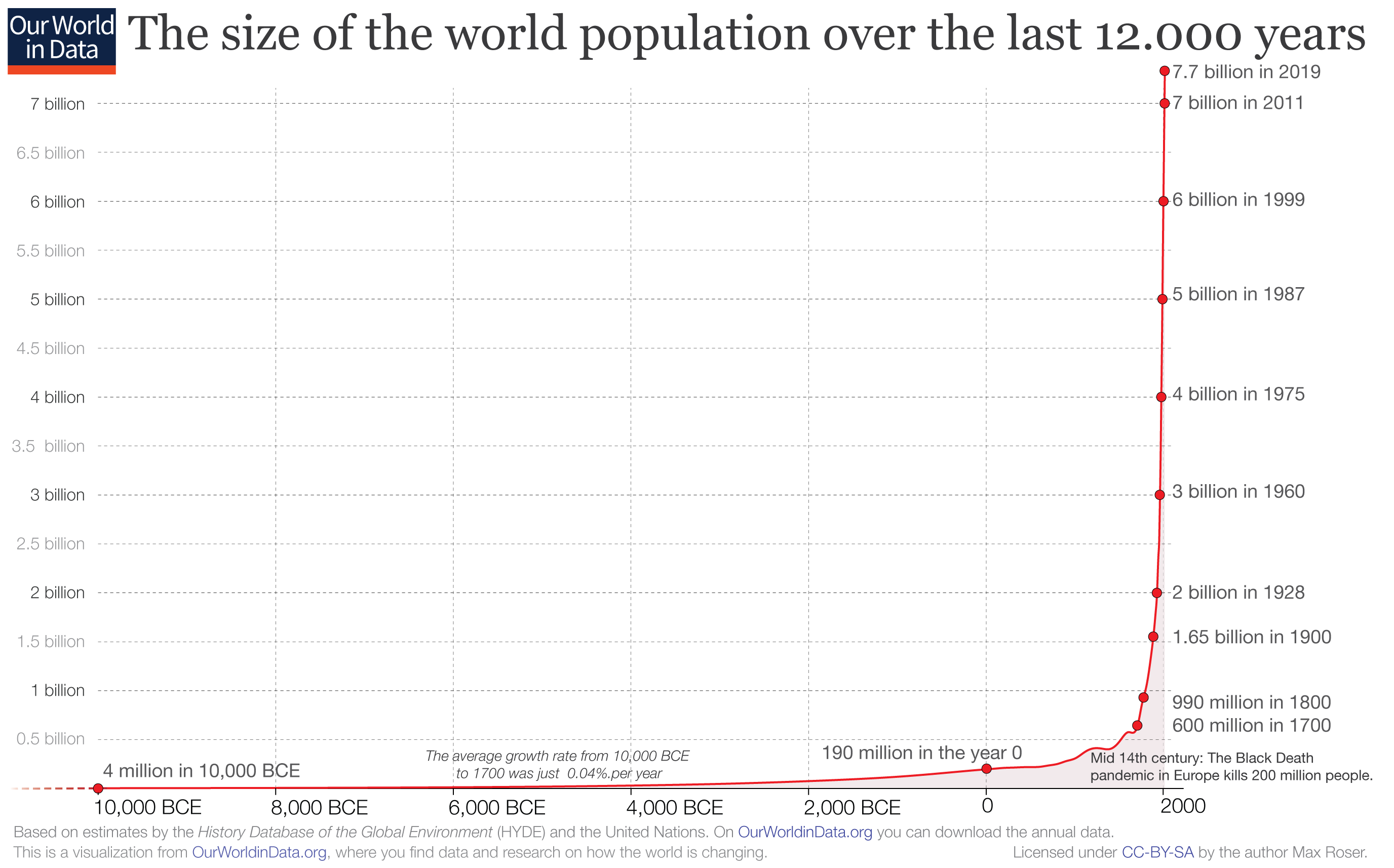
Basic knowledge about world population growth is essential to better follow the timeline story.
You can see in the graph that the population was much lower over a long period. For the time since 1000 BC (so about 3000 years ago from our perspective) there are fairly reliable estimates. At that time, about 50 million people lived spread out across our beautiful planet. Numbers before that are more difficult to give, but a realistic estimate is possible. The Bible provides us with two clear milestones: Creation and the global Flood. Recently, these milestones can also be substantiated by our insight into the genetic family tree! You can find more information about this under: The DNA family tree of 8 billion people.
The Genesis account tells how our world began. Not hundreds of millions of years ago and not with ape-men, but with the Creator's powerful word. Our lives are incredibly wondrous and are a testimony to God, who conceived and created all of this. When human DNA was mapped around the year 2000, one of the remarkable conclusions was that all people ultimately belong together. It is one family. The New York Times published an article about this: Angier, N. (2000, August 22). Do Races Differ? Not Really, Genes Show. Nytimes.com. https://www.nytimes.com/2000/08/22/science/do-races-differ-not-really-genes-show.html. The apostle Paul already said the same thing some 1,950 years earlier during his meeting on the Areopagus in Athens (Acts 17). From the very beginning, this is the story of the Bible. The world population began 6,000 years ago, with one man and one woman. So just look around you—everyone you see is actually related to you!
The world population hasn't grown continuously since its inception. At some point, our ancestors deteriorated to such an extent that God deemed it time for a "Great Reset." This occurred about 4,500 years ago. The global flood not only profoundly changed the geology of our planet, but also, and more importantly, revived humanity. Eight people survived. No one else, anywhere. From these three families, the entire current world population originated (Genesis 10:32). This doesn't fit mainstream models, but it's true nonetheless.
The timeline tells the story of God's great project. Throughout time and generations, He forms a community of people with whom He desires to live forever in a covenant of love. But world history shows that this plan is fragile. It cannot be achieved through displays of power, manipulation, and censorship, but entails the risk of love and freedom. From the very beginning, humanity has gone its own way. As incredible as it is, not everyone wants to be part of God's fantastic future. Instead, we prefer to believe the lie of a self-made life. We build our own Tower of Babel and try to create our own happiness, personally and globally. This has consequences.
In the timeline, you can read and hear about the miraculous things God has done to solve the core of this problem. But this isn't the end. Jesus will come again, this time not as a carpenter's son, but as the CEO of the universe. From that day on, at the end of world history, the world's population will be reset to zero. This will remain the case until God establishes the new heaven and the new earth. Then Jesus' promise will be fulfilled: "Blessed are the meek, for they will inherit the earth" (Matthew 5:5 - a renewed earth). Hopefully, as many people as possible will be there.
Will YOU be there too?