


You've probably noticed that the timeline doesn't calculate in millions or billions of years. According to the Bible, world history is no more than about 6,000 years old. This dating, to put it mildly, creates friction with popular scientific theories. So is the timeline based on naive fantasy? Or is there scientific support for such a model? You might be surprised, but there's plenty of evidence. Check out the timeline and see for yourself!

Secular science (i.e., science that a priori has chosen to exclude God from the university) claims to know a great deal about the history of our lives. Yet, many skilled christian scientists, based on clear arguments, thorough fieldwork, and confidence in the Biblical account, endorse a very recent history. This raises fundamental questions about science in general. We shouldn't shy away from them. What can we actually "know"? And is it true that trust and unprovable assumptions play a decisive role in modern science?
Numerous findings and arguments support the claim that world history isn't nearly as old as mainstream models claim. Here are a few examples (more to follow later in the timeline).
In most scientific publications and journals, it's a given that dinosaurs lived on our planet at least 65 million years ago. But in 2007, Dr. Mary Schweitzer made a remarkable discovery. During her excavations in the Hell Creek Formation in Montana, she found the remains of a Tyrannosaurus rex. This happens quite often. But to her great surprise (as an evolutionary scientist), she also found associated remains of tissue, blood vessels, and protein fragments. She published her findings in the scientific journal Scientific American (December 2010, pp. 62-69). Evolutionary scientists reacted with considerable revulsion. How can you reasonably explain that tissue remains still exist after 65 million years? Those evolutionary scientists who understood this presented an insoluble problem immediately proposed a theory that there must be some as-yet-unknown natural process that explains this. From a biblical timescale, it presents no problem at all. Once you accept that humans and dinosaurs coexisted, the murals found, like the one below, suddenly don't seem so strange. The book of Job also describes one (Job 40:10-19), the largest land animal, with a tail "like a cedar").
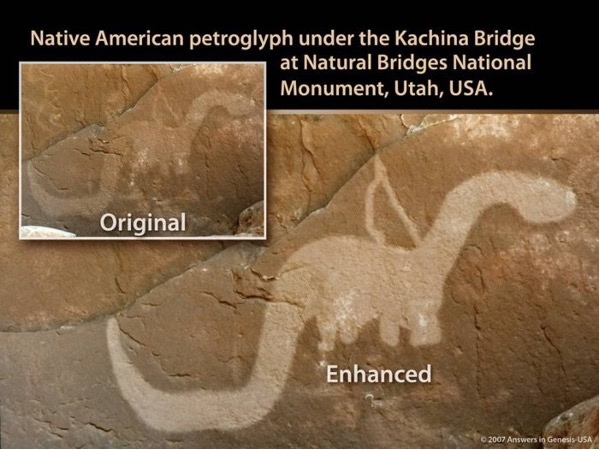
Kachina Bridge Dinosaur Petroglyph
https://answersingenesis.org/dinosaurs/humans/kachina-bridge-dinosaur-petroglyph/
The entire world population as we know it today, from Aztecs to Aboriginals and New Yorkers, emerged in a period of just 4,500 years. During this time, our ancestors spread across the globe, migrated multiple times, and interbred in various ways. Read more about this astonishing conclusion in several parts of this website. You'll find an explanation of what the genetic family tree tells us about the origins and development of the world's population!

The impressive Grand Canyon must have formed in just a few months. This is evident from recently published research into the canyon's deepest layers. It is a clear echo of the global catastrophe of Noah's Flood. During this gigantic geological dynamic, the present-day continents split and shifted, creating high mountain ranges like the Himalayas. The strong warming of the oceans, combined with ash from large-scale volcanic activity, created an ice age climate for several hundred years. Read more about this interesting stuff under the Global flood tile in de timeline.
Creationist physicist Dr. Russ Humphreys successfully predicted Neptune's magnetic field two years before Voyager II flew by (in 1986), based on an age of 6,000 years. Interested in the stars? Here's a great lecture on the age of the cosmos from a Young Earth Creation (YEC) perspective:
Secrets of the Cosmos that Confirm the Bible – Dr. Jason Lisle - YouTube
https://m.youtube.com/watch?v=afXQomQ7Gqo
In many traditions worldwide, the idea exists that the universe is "eternal." It's remarkable that modern science, while still calculating with astronomical numbers, has abandoned the idea of an eternal universe. Everything points to a beginning. There's considerable disagreement about when that was and how it came about, but the first sentence of the Bible ("In the beginning...") isn't so outlandish.
These are just a few examples from the fields of geology, archaeology, microbiology, and cosmology, illustrating that the Bible tells an exceptionally reliable story. Want to delve deeper into this because it raises all sorts of understandable questions? That's a good idea! There's a wealth of material available.
One of the most well known organizations active in this research is AnswersInGenesis.
Another great team is Creation Ministries Internationals, who published tons of interesting material and interviews with Christian scientists.
Home - United Kingdom · Creation.com
And there are many more. The mainstream education system - for the most part inspired by the Jesuit order (which you will learn about in the timeline) - has abandoned creation science altogether. But don't be fooled. With a little effort on your side you will discover how much material there is to find that support the Biblical account.
Discussions about time calculations are sensitive. Time is the basis of evolution. And evolution is the foundation of the secular worldview. If it were to turn out that the vast timescales of millions and billions of years are incorrect, and the Earth is still very young, this structure would collapse like a house of cards. Everyone understands that mega-complex living organisms could never arise in a period of just thousands of years through a spontaneous process of random mutations. Evolutionary development of life (apart from the immense difficulties with the theory as such) takes time, at the very least. A lot of time, a immens great deal of time.
Questioning established theories about life is not a purely intellectual pursuit. It touches on our hopes and fears, our existential questions, our responsibility as human beings, and the desire to live a meaningful life. The main goal of thecomingworld.com is not to criticize mainstream scientists, but to demonstrate that there is a wonderful, reliable, and hopeful alternative! An alternative that you too can join.
Genesis 1–11 (earliest history)
Matthew 1 and Luke 3 (generation lines)
Romans 5 (about the 'first' and 'second' Adam)
Psalm 19 (about the universe, the words of the covenant, awe for this special God, and the testing of one's own heart)